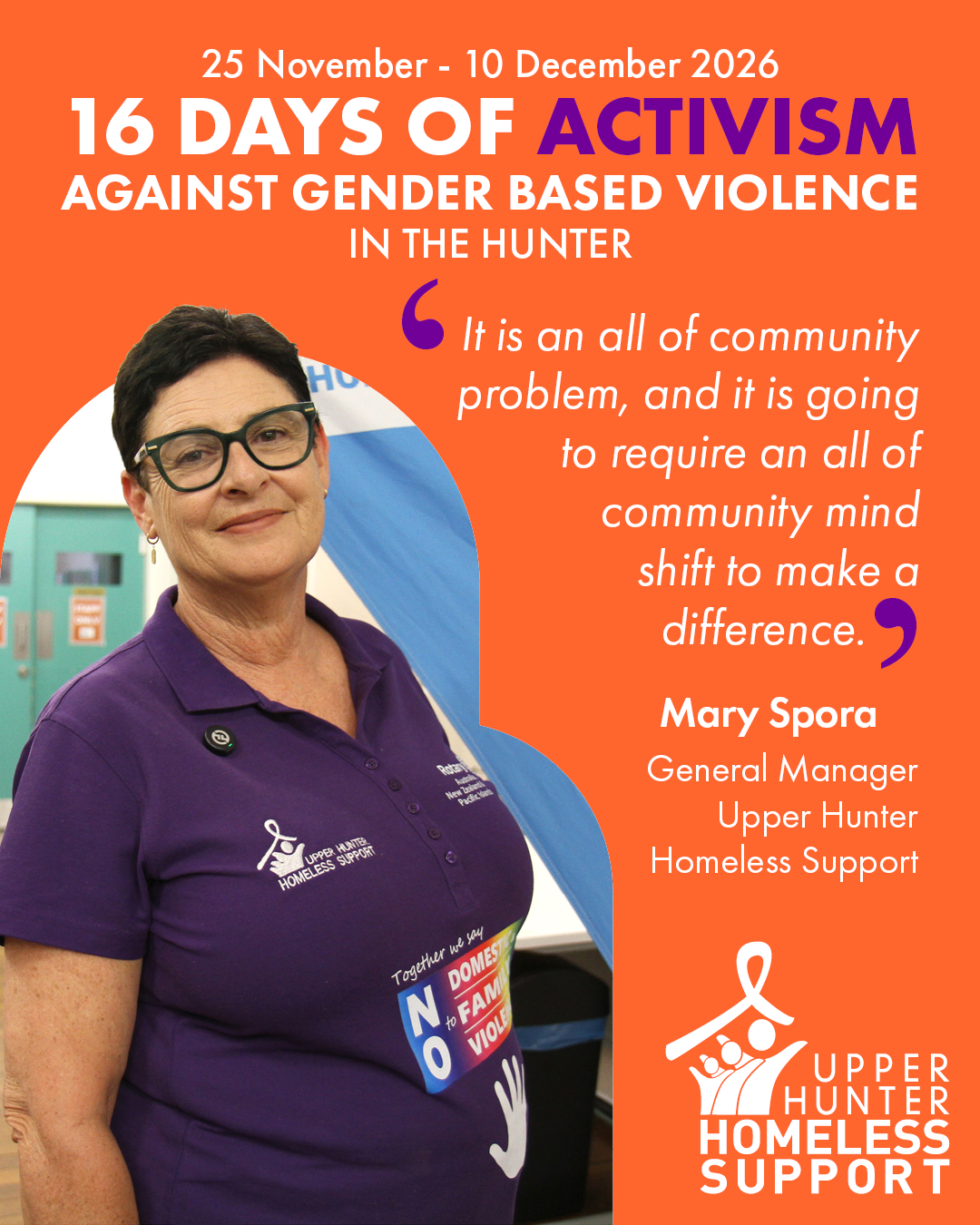

“It is an all of community problem, and it is going to require an all of community mind shift to make a difference.” Mary Spora, Upper Hunter Homeless Support.
“Domestic violence is a really tricky situation, however, it is an issue that if we move the dial, talk more about it, educate our community, things will change because we will have people who recognise signs in their own relationship, in others’ relationships, earlier, and can know that there’s something you can do about it.”
Increased community awareness around domestic and family violence is a positive shift that Mary has seen in the last decade, but there is still a way to go in breaking the stigma attached to the subject.
She shared that many people still feel like the issue needs to be hidden away rather than speaking up if something does not seem right, for themselves or for someone else.
“A great example of community awareness is Scone Rotary, who used November and 16 Days of Activism to actively try and get businesses in Scone to show their support for awareness about domestic violence.
“Now, that would not have happened a decade ago, so we have people talking about the issue. We have people more aware that it is an issue, and that can only be a good thing because when we don’t talk about it, when we hide it away, nothing gets done.”
Along with breaking the stigma against talking about family and domestic violence, there is the generational trauma and ongoing cycle that is created as children grow up in homes witnessing and experiencing this behaviour.
“You have children going to school who are profoundly affected by what’s gone on in their home, and they are never going to tell anybody what’s gone on,” Mary shared.
“It is an issue across our society, and the sad thing about it is because it affects children, we have generational cycles.”
“Before I came to Upper Hunter Homeless, I worked in youth in the Upper Hunter, and whenever you work in the youth space, you hear about homelessness and you hear about domestic violence. You hear the stories from children who are coming to school talking about how they protected their younger brothers and sisters last night and what they do, what their plans are.”
Community education about family and domestic violence is significant in breaking these cycles.
If someone is in immediate danger, calling Triple Zero (000) to get support from emergency services should always be the first thing you do.
But if there is no immediate danger Mary recommends getting more information to move forward.
“Our website has a whole lot of links to really great websites where you can find out more. You can ring 1800 RESPECT (1800 737 732) and ask about it, and you might talk about a situation that you’ve seen, or the New South Wales Domestic Violence Hotline.
“You can ring people like that and just go, ‘I’m worried. I’m worried about myself, or I’m worried about a friend, or I’m worried about a neighbour.’
“There is a lot you can do behind the scenes to empower yourself and get more information.”